Who we are, Vision and Future Development:
About CADRC-Initiative
The CADRC-Initiative is a Dallas-anchored scientific platform focussed on the stepwise computation and interpretation of biological sequences. Our works begins at the signal at the signal level of the biological information.
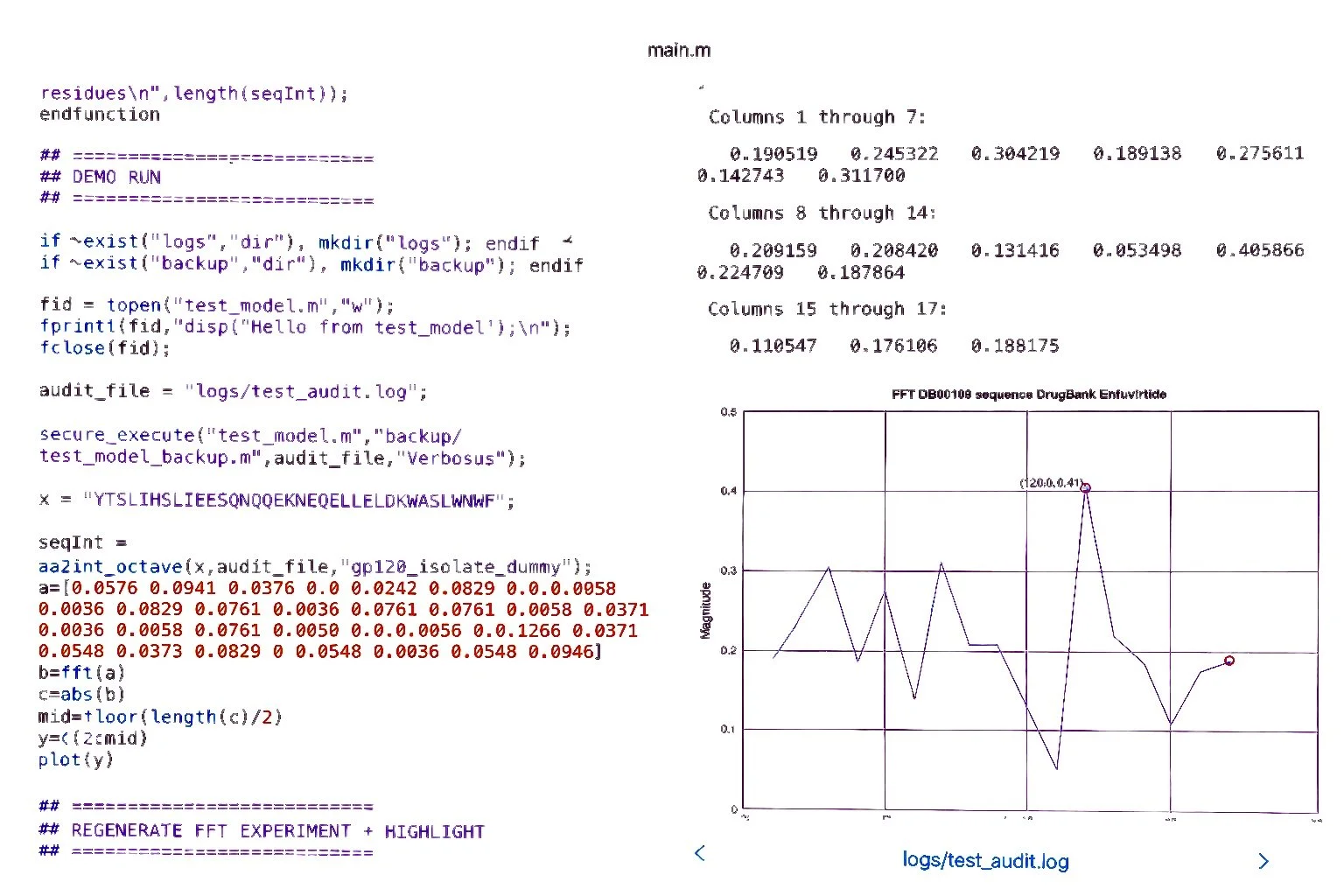
We translate biological sequences into analyzable signals and apply Fourier-based and source-verified computations to uncover structure, interaction logic and functional signatures that are often invisible to mutation-only or heuristic systems.
Our purpose is to build a transparent, reproducible and reliable computational environment where every analytical step is traceable, experimentally accessible and grounded in the underlying mechanism of the sequence investigated.
Vision:
Our long‑term vision is to establish a stable, lifelong scientific institution dedicated to mechanistic computation of biological function. CADRC aims to become a center where:
• biological sequences are treated as functional signals, not static strings.
• computation reflects biological causality, not black‑box prediction.
• students and researchers gain access to clear, source‑verified workflows.
• mechanistic reasoning becomes the default language of biological analysis.
This vision expands into the creation of the Center for the Calculation of Bio‑Functionalities (CCBF) — a future hub for sequence‑centric modeling, mechanistic interpretation, and educational outreach.
The CADRC Initiative forms the computational foundation for CCBF, with today’s sequence‑centric, FFT‑based workflows serving as the first stage in a broader progression toward real‑time calculation of biological functionalities.
Norbert Nwankwo -Founder
Inventor/Assignee
CONNECT WITH US
Future Development
CADRC is building a computational ecosystem designed for long‑term scientific growth. Our development roadmap includes:
• Mechanistic Modeling Modules
Expanding FFT‑based and signal‑derived computational tools that map biological interactions through competitive‑analogue mechanisms and functional resonance patterns.
• Deterministic Workflow Infrastructure
Strengthening provenance‑protected pipelines where every computation is logged, reproducible, and verifiable.
• Educational Expansion
Creating student‑friendly learning materials, public notes, and mechanistic explanations that make advanced computation accessible without sacrificing rigor.
• Institutional Integration
Evolving CADRC into a recognized scientific center (CCBF) with a unified identity, stable governance, and a long‑term research trajectory anchored in Dallas.
Our development is guided by one principle:
Biological function is mechanistic, and computation must reflect that mechanism.